
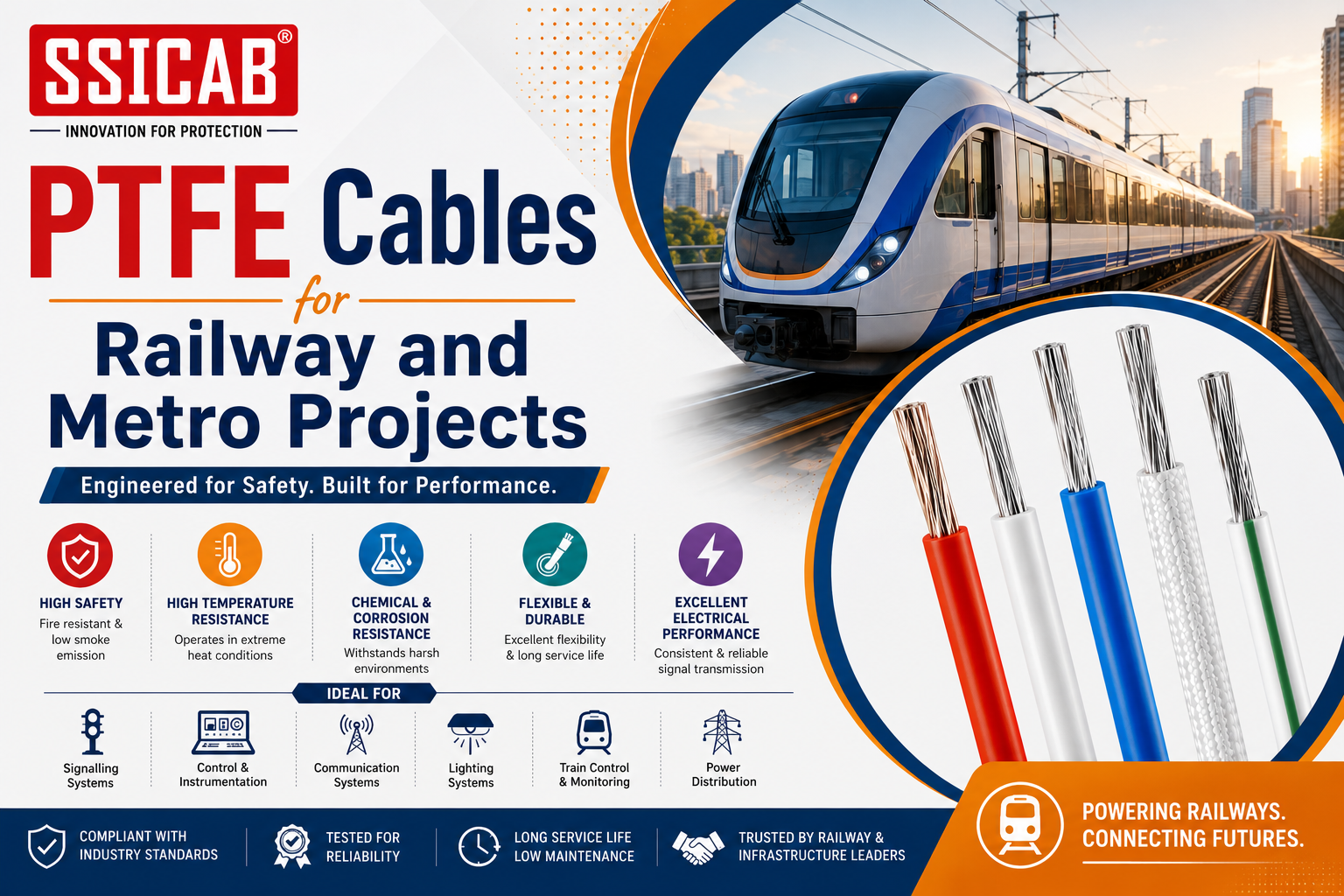
Everyday, millions of people depend on railway & metro systems for safe and timely travel. As travelers observe trains, stations, and modern carriages, a vital element stays concealed—the cable systems that power, control & monitor the whole operation.
Cables are essential for maintaining efficient train operations, from signaling systems and communication networks to braking controls and onboard electronics. Selecting an incorrect cable may result in regular maintenance, unanticipated outages, and increased operational expenses.
This guide by SSI Cables of PTFE (Polytetrafluoroethylene) cables are preferred for railway and metro projects. Their capability to operate in challenging conditions makes them appropriate for uses where safety and dependability are essential.
Why Railway & Metro Projects Need High-Performance Cables?
Unlike traditional industrial environment, railway infrastructure places continuous stress on cables. They are anticipated to deliver result regardless of:
- Constant vibration from moving train
- Variation in high & low variations
- Exposure to oils, fats, humidity & cleaning agents
- Continuous electrical loads
- Long operating hours with less maintenance opportunities
A cable that may perform well in factory may not necessarily deliver the same result in a railway application. This is why engineers focus on long-term performance rather than just the initial cost.
What Makes the PTFE Cables Different?
PTFE is among the most advanced insulation substances used in electrical wires. It provides a mix of thermal, electrical, and mechanical characteristics that are hard to attain with traditional insulation materials. Some of the major advantages include:
- Operates reliably from -65 degree Celsius to + 260 degree Celsius
- Excellent resistance to heat & fire
- High insulation resistance for stable electrical performance
- Resistant to oils, fuels, chemicals & moisture
- Excellent flexibility for compact installation
- Long service life with less insulation ageing
- Low maintenance requirement
These properties make PTFE cables particularly suitable for mission critical railway system.
Technical Specifications of PTFE Cables for Railway & Metro Projects:
When evaluating PTFE cables, engineers typically look beyond the insulation material. The complete cable construction determines how well it will perform throughout its service life.
| Basis | Description |
| Conductor Material | Annealed Copper, Silver-plated Copper, Tinned Copper, Nickel-plated copper |
| Insulation | 100% virgin PTFE insulation, High dielectric strength, excellent thermal stability, Superior abrasion resistance |
| Operating Temperature | Minimum: -65°C Maximum: +260°C Short- term exposure: Up to 300°C |
| Voltage Rating | 300/500V, 600V, 1000V |
| Fire Performance | Flame-retardant performance, low-smoke emission, self-extinguishing insulation, low toxicity during fire condition |
These characteristics of PTFE cables by SSI Cables are particularly important in underground metro stations and passenger coaches
Where are PTFE Cables Used in Railway & Metro Systems?
A modern railway track contain millions of connections as PTFE cables are commonly used in applications where reliability is essential.
- Signaling Frameworks: Railway signals need to provide accurate information consistently. PTFE insulation ensures the preservation of signal quality even under challenging operating conditions.
- Control Consoles: Electrical control panels produce heat while functioning continuously. PTFE cables retain their stability while preserving their insulating characteristics.
- Rolling Equipment: Within locomotives and metro cars, cables undergo continuous motion and vibration. PTFE offers the needed flexibility and durability for an extended lifespan.
- Communication Networks: Passenger announcements, communication in control rooms, CCTV, and operational networks rely on cables that possess exceptional electrical performance.
- Instrumentation and Sensors: Brake monitoring, temperature sensors, pressure monitoring, and diagnostic tools necessitate dependable signal transmission, making PTFE a perfect option.
Key Factors to Consider Before Selecting PTFE Cables:
Before purchasing PTFE cables, project teams should check more than just a price. Consider the following question:
- What is the maximum operating temperature?
- Will the cable be exposed to chemicals or oils?
- Does the application require high flexibility?
- Is electromagnetic interference a concern?
- What voltage rating is required?
- Which industry standards must the cable meet?
- How important is fire safety performance?
Why Manufacturing Quality is as important as Material Quality?
Even the best insulation material cannot compensate for poor manufacturing. A reliable PTFE cable should be produced with:
- Precision conductor stranding
- Uniform insulation thickness
- Accurate dimensional control
- High-voltage testing
- Spark testing
- Conductor resistance testing
- Insulation resistance testing
- Strict quality inspection throughout production
Consistent manufacturing ensures that every cable performs as expected in demanding railway environments.
Why Choose a Reliable PTFE Cable Manufacturer?
For railway & metro projects, selecting the right manufacturer is as important as selecting the right cable. Look for the manufacturers that offers:
- High-quality raw material
- Application-specific cable design
- In-house testing plants
- Compliances with relevant industry-standards
- Consistent manufacturing process
- Technical support for project-specific requirements
At SSI Cables, PTFE Cables are produced with accurate engineering and strict quality control to satisfy the strict requirements of industrial, railway, and metro uses. Each phase—from choosing materials to final testing— helps in ensuring reliable cable performance in essential operating conditions.
Best PTFE Cable Manufacturer – SSI Cables:
Railway and metro initiatives require cable solutions capable of operating reliably for years in difficult environmental conditions. PTFE cables offer the right combination of heat resistance, electrical stability, chemical resistance, and durability to meet these criteria.
Rather than considering the costlier nature of PTFE cables, it would be more sensible to pay more to their advantages in the long run. This includes reduced maintenance, increased reliability of systems, and improved safety of operations.
Frequently Asked Questions:
Due to their high heat-resistance, electrical insulation, fire retardance, and durability under tough conditions of operation.
PTFE cables have an operating temperature range from -65°C to +260°C and can withstand even higher short term temperatures up to 300°C.
Silver-plated copper conductors are popular and so are tinned copper conductors.
Yes. Their excellent dielectric properties help maintain signal integrity and reliable electrical performance.
Our company specializes in precision production, rigorous quality testing, and application-oriented design, thereby producing PTFE cables that are optimized for long-lasting use in the railway and metro industry and beyond.