
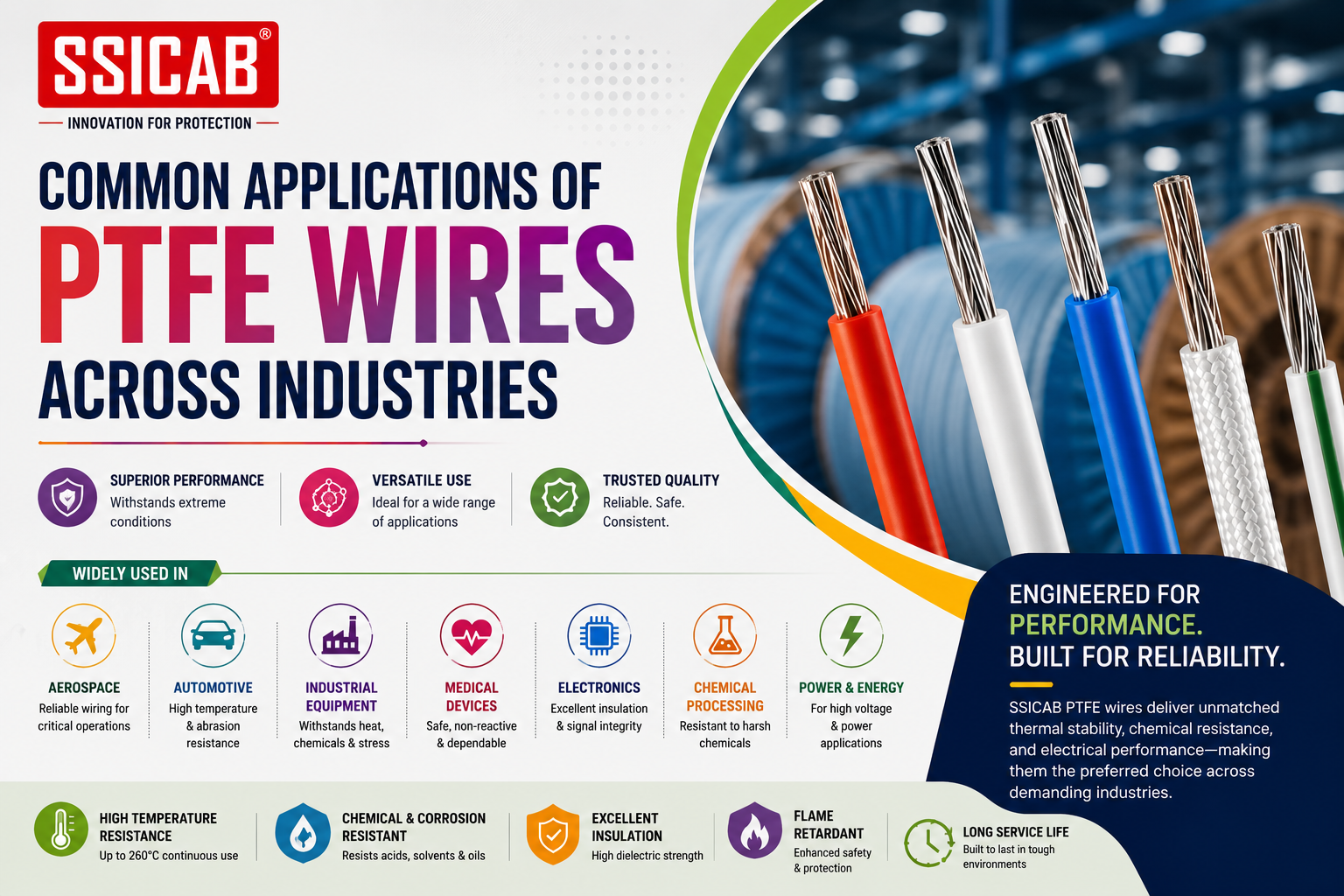
Not only does choosing the right kind of cable depend on meeting the technical requirements, but it also determines how reliable the equipment will be and how safe it will be to use. Where there is an ongoing exposure to heat, chemicals, moisture, or stress, regular cables usually end up working at their peak capacity.
This is where engineers in various areas turn to PTFE (Polytetrafluoroethylene) cables. Their thermal and chemical resistance and insulation properties make PTFE cables an obvious choice where failure is unacceptable.
Why PTFE Wires Stand Out?
PTFE insulation is designed to perform in demanding operating conditions while maintaining uniform electrical & mechanical properties. Compared to traditional insulation materials, PTFE offers:
- High temperature resistance (up to 260 degree celcius)
- Excellent resistance to chemicals, oils & solvents
- Superior dielectric strength
- Flame-resistant properties
- Low moisture absorption
- Long service life with less aging
For PTFE Wires Manufacturers, these characteristics contribute to reduced maintenance, increased machine reliability, and ensure constant production.
Common Applications of PTFE Wires Across Industries:
- Aerospace & aviation:
Aircraft systems work in harsh environments with drastic changes in temperatures, vibrations, and weights. The applications of PTFE wires include:
- Aircraft wiring harnesses
- Avionics systems
- Engine compartments
- Navigation equipment
- Communication systems
Their lightweight design, outstanding insulation capabilities, and heat resistance make them ideal for aerospace applications where dependability cannot be sacrificed.
- Automotive manufacturing:
Modern vehicles contain increasingly complex electrical systems operating close to engines, batteries, and exhaust assemblies. PTFE insulated wires are widely used for:
- Engine compartment wiring
- Electric vehicle battery systems
- Sensors
- Control units
- High-temperature cable assemblies
As electric vehicles advance, manufacturers are focusing more on cable materials that can withstand elevated operating temperatures while ensuring electrical stability.
- Medical Equipment:
It demands accuracy, cleanliness & long-term reliability. PTFE insulated wires are widely used for:
- Diagnostic equipment
- Imaging systems
- Surgical instruments
- Laboratory devices
- Patient monitoring system
Their chemical resistance and ability to handle sterilization processes make them particularly valuable in healthcare environments.
- Industrial Automation:
Modern factories depend significantly on automated equipment that functions nonstop within challenging production timelines. The PTFE wires are commonly used in:
- CNC machines
- Robotics
- Control panel
- PLC system
- Servo motor
- Industrial sensor
Because production downtime directly impacts profitability, manufacturers often prioritize cable reliability over replacement frequency.
- Chemical Processing Plants:
Chemical industries expose cables to corrosive substances, solvents, acids, and harsh cleaning agents. PTFE insulation provides dependable protection for wiring used in:
- Processing equipment
- Pumps
- Valve
- Instrumention
- Chemical reactors
- Monitoring system
Its excellent chemical resistance helps in maintaining cable integrity even in high processing environments.
- Oil & Gas Industry:
Oil and gas operations present a combination of heat, chemicals, vibration, and outdoor exposure. PTFE wires are widely used in:
- Drilling equipment
- Control system
- Instrumentation
- Off shore platform
- Refinery automation
The ability to maintain insulation performance under harsh environmental conditions supports safer and more reliable operations.
Factors to Consider Before Selecting PTFE Wires:
While PTFE wires provide considerable performance benefits, they are not the perfect choice for all applications. During cable selection, engineers generally evaluate:
- Maximum operating temperature
- Chemical exposure
- Voltage rating
- Mechanical flexibility requirements
- Installation environment
- Regulatory Compliance
- Expected service life
Choosing a cable purely for its price may result in early breakdowns, more maintenance, and greater overall costs. Assessing the entire operational landscape frequently leads to greater long-term benefits.
Why Manufacturing Quality Matters?
Even the best insulation material cannot compensate for inconsistent manufacturing practices. The reliable PTFE wire depends on:
- High-purity raw materials
- Accurate conductor design
- Uniform insulation thickness
- Strict process control
- Comprehensive electrical testing
- Compliance with industry testing
These elements directly affect the cable’s durability, electrical efficiency, and long-term reliability in industrial uses.
Firms like SSI Cables opt for regulated production processes, quality testing, and custom-made cables to assist in areas where electrical performance is important.
Best PTFE Cable Manufacturer – SSI Cables:
PTFE cables are becoming an essential part of many industries where dependable performance under conditions of high temperatures, corrosive environments, or electrical sensitivity is required. The properties of thermal stability, chemical resistance, and electrical reliability make them a good choice for applications with requirements for continuous performance.
In the wake of improvements in processes and machinery that operate in stricter environments, selecting the right type of cable has become not just a matter of specification, but one of smart operations. By collaborating with a seasoned cable manufacturer who knows about the demands of the application, the quality standards and engineering challenges, they will be in a position to develop better and safer systems.
Frequently Asked Questions:
PTFE wires are found in such sectors as the aerospace industry, automotive industry, medical equipment, automation systems, chemical industry, oil & gas sector, electronics industry, and railway industry.
PTFE insulated wire can function at 260 degrees Celsius and has good performance in terms of both electrical and mechanical properties.
Yes, PTFE is characterized by great resistance to acids, solvents, oils, and most other industrial chemicals.
Heat, water, chemical, and age resistance ensure better reliability and help prevent insulation troubles and maintenance expenses.
They need to consider quality control, industry standards, precise manufacturing, and expertise in supplying cables based on applications.
Accuracy in manufacturing, quality assurance, and applicability are some features of SSI Cables that make its PTFE wires reliable.