
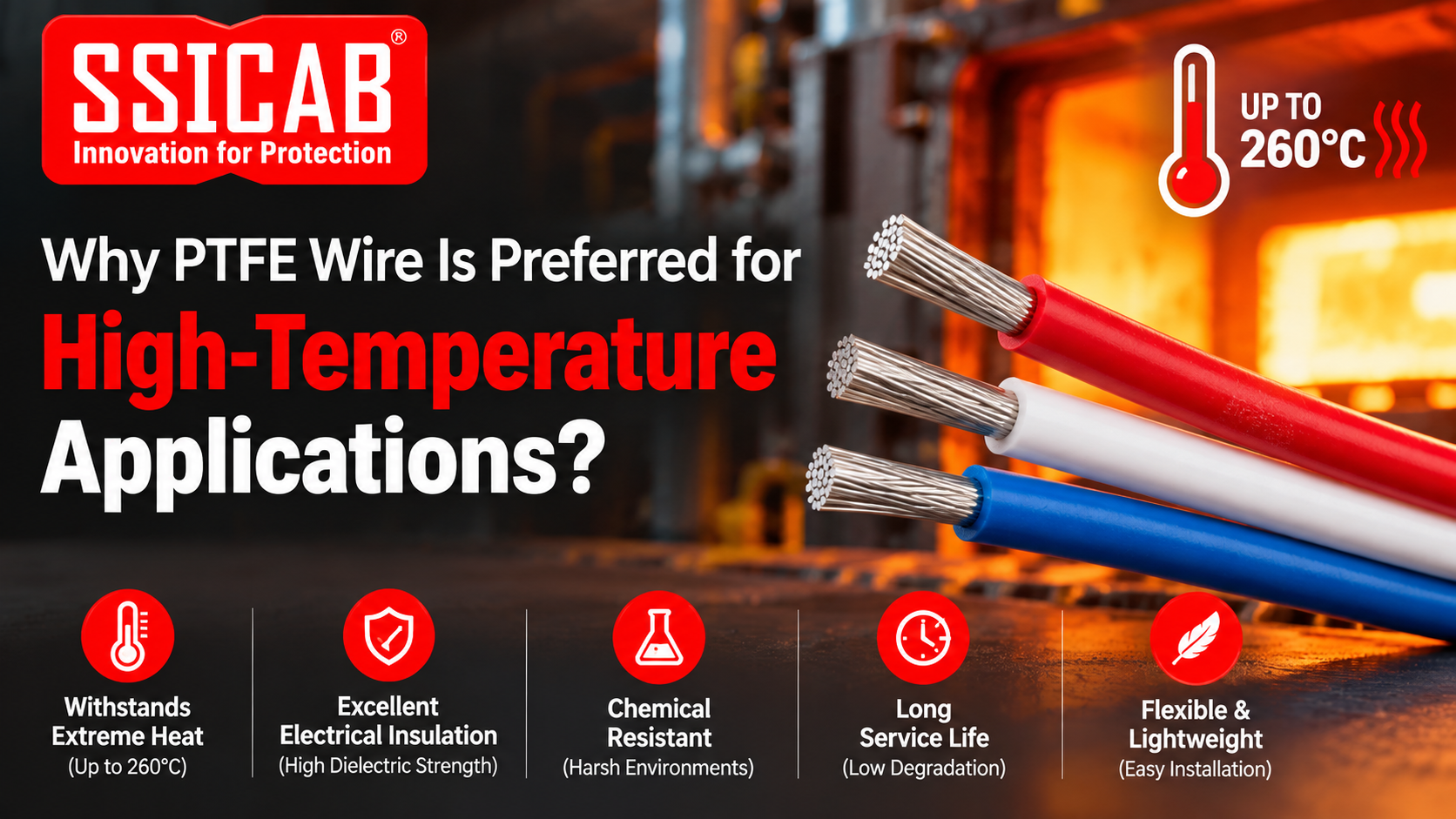
An environment of high temperature for an electrical conductor requires not only the ability to conduct electricity but also insulation that would withstand the conditions of high temperatures, electrical stress, chemicals, humidity, and mechanical stresses without failing in its insulating function. This is where the PTFE Wire produced by SSI Cables comes into play for tough industrial and electrical applications.
PTFE (Polytetrafluoroethylene) is a fluoropolymer noted for its unique thermal stability, chemical resistance, low friction, and good dielectric strength.
What Makes PTFE Wire Suitable for High Temperatures?
The key benefit associated with PTFE cables lies in the fact that PTFE can sustain their insulation properties over a wide range of temperatures. On average, PTFE is capable of working at temperatures reaching 260 degrees Celsius. The key benefits include:
- Good thermal stability: The insulation will be functional in hot conditions and will not soften or degrade.
- Dielectric strength: It offers good insulation from electricity and thus reduces the chances of breakdown.
- Resistance to chemicals: PTFE is resistant to oils, solvents, acids, and many other corrosive substances.
- Low moisture absorption: It has low moisture absorption, ensuring that the insulation works in difficult conditions.
- Flame resistant: PTFE has high flame resistance.
- Long life span: Resistance to degradation and high temperatures ensures that it has a long life span.
PTFE Wire vs Traditional Insulation:
Insulation material that is conventional may be appropriate to use in electrical circuits that are ordinary, but the temperature ranges of such materials may not make them appropriate for use in harsh environments. For instance, the normal operating temperature of PVC is much lower than that of PTFE.
| Property | PTFE Insulation | Traditional PVC Insulation |
| High temperature capability | Excellent | Moderate |
| Chemical resistance | Excellent | Moderate |
| Dielectric performance | Excellent | Good |
| Moisture resistance | Very high | Good |
| Suitable for harsh environments | Yes | Application dependent |
| Long-term thermal stability | Excellent | Lower at elevated temperatures |
Where Is PTFE Wire Used?
PTFE wire is commonly selected for equipment and systems exposed to heat, chemicals, or electrical stress. Typical applications include:
1. Aerospace and Defence
Aircraft and defence systems require lightweight, reliable wiring capable of operating under demanding environmental conditions. PTFE insulation can provide the required thermal and electrical stability.
2. Industrial Equipment
High-temperature machinery, control systems, heating equipment, and industrial automation may use PTFE-insulated wires where conventional insulation is unsuitable.
3. Railway and Metro Systems
Electrical wiring used in railway and metro applications can face heat, vibration, electrical stress, and strict safety requirements. PTFE wires can be selected for applications requiring reliable insulation performance under such conditions.
4. Automotive and EV Systems
Components located close to engines, motors, batteries, and other heat-generating systems can require specialised high-temperature wire insulation.
5. Instrumentation and Control
PTFE wire is also useful in instrumentation systems where stable electrical insulation and resistance to environmental conditions are important.
Why Wire Construction Matters?
Choosing the correct PTFE wire does not simply involve using PTFE as the insulator material; conductor material, conductor size, voltage rating, insulator thickness, temperature rating, flexibility, and other relevant factors will need to be taken into account.
For instance, equipment that is likely to experience constant movement might require a construction that is quite different from the one for a static control panel.
PTFE Wire for Reliable Performance:
As a wire suitable for high temperature electrical applications, PTFE wire is a material that provides a number of properties which will allow it to serve as an appropriate option from the engineering standpoint. Nevertheless, one needs to use the right wire depending on particular conditions.
At SSI Cables we provide various types of industrial cables and wires. Using the right specification of PTFE wire may improve electrical reliability, minimize insulation failures, and increase life span.
Frequently Asked Questions:
- What is PTFE wire?
It is an electrical wire insulated with Polytetrafluoroethylene, a high-performance material known for excellent heat & chemical resistance. - What temperature can PTFE wire handle?
PTFE insulation can typically handle continuous temperatures of around 260 degrees Celsius, which depends on the wire construction & applications. - Why is PTFE wire preferred for high-temperature applications?
It offers excellent thermal stability, dielectric strength, chemical resistance & long-term insulation performance. - Where is PTFE wire commonly used?
It is used in aerospace, railway & metro systems, industrial machinery, automotive, EVs & instrumentation applications. - Is PTFE wire better than PVC wire for high temperature?
Yes, PTFE wire generally provides higher temperature & chemical resistance than traditional PVC insulation, which makes it better suited to demanding environments.